Wednesday, 8 March 2023

100+ Small Paintings Challenge – Another Update

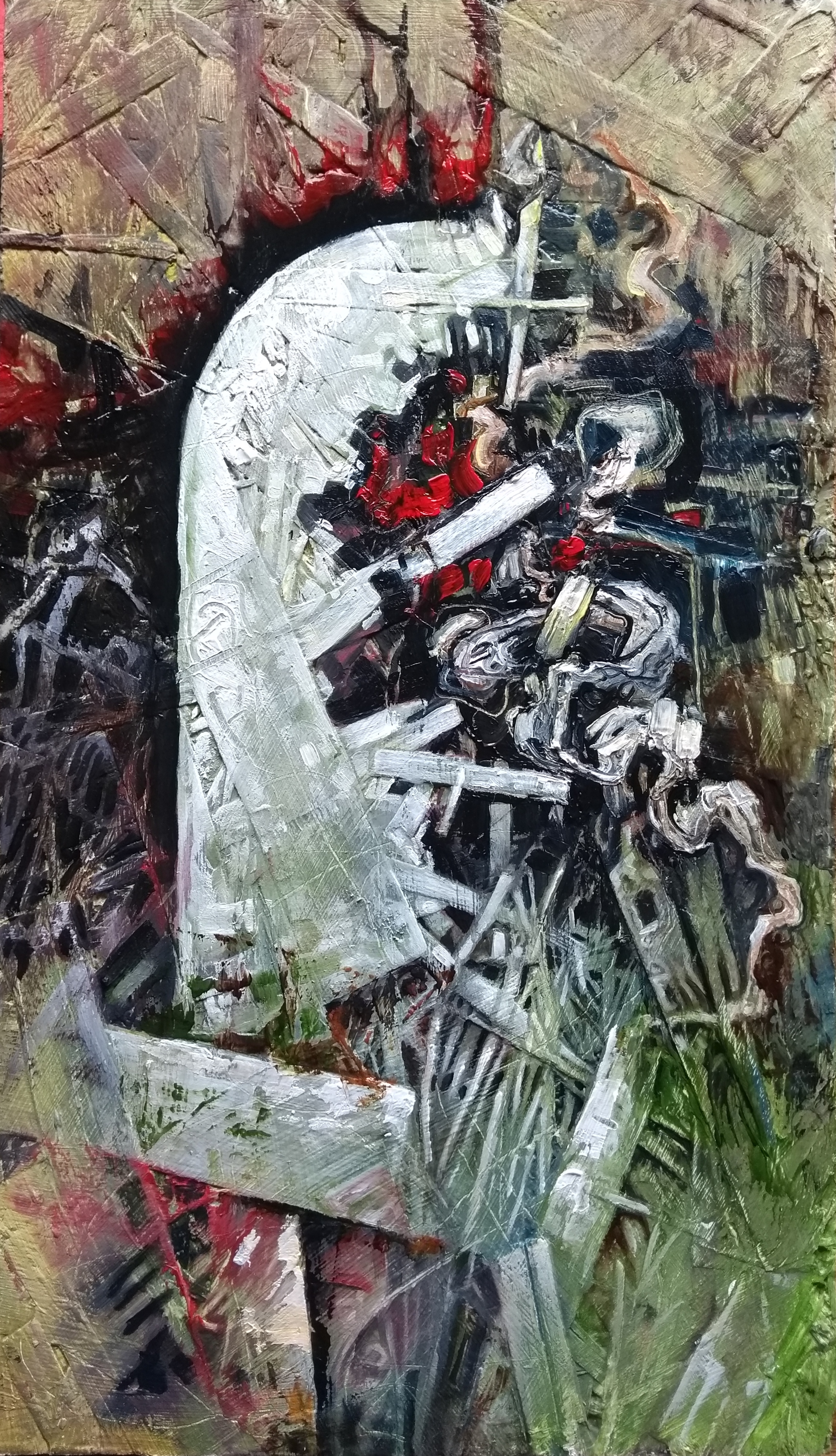
Back in January 2020 I decided to set myself a challenge of seeing how many small oil paintings I could produce in a 12 month period. By the end of the challenge I’d created just over 100 paintings (initially I thought about aiming for 1000 paintings but I soon realised that this wouldn’t leave me time for any other art projects, and might send me potty).


'Explosive Entropy', 2020, oil on board, Wayne Chisnall

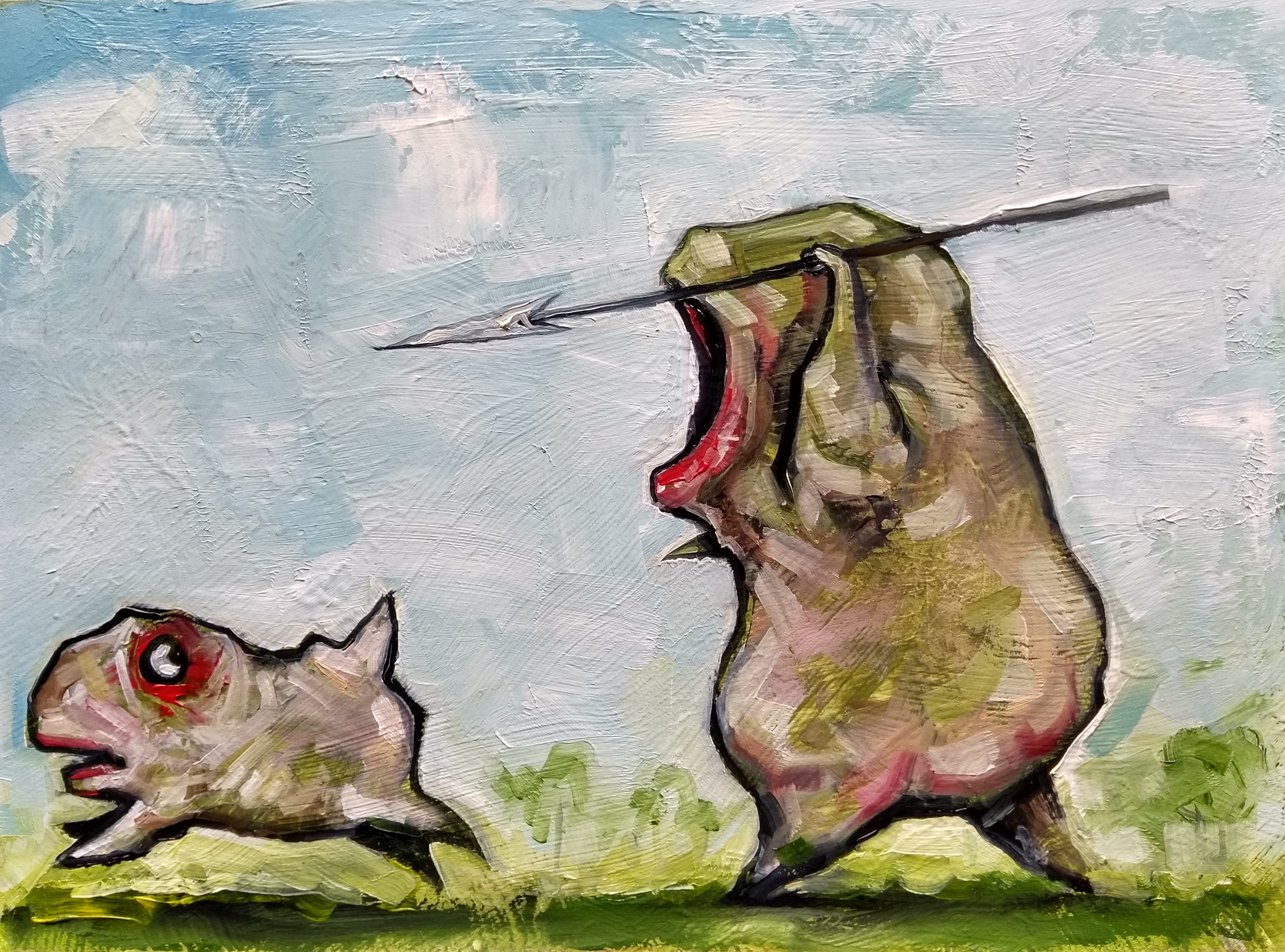
Not wishing to overload my blog with photos of works from just this one project I decided to post about it in small chunks, over several posts. So far I’ve posted around 60 of them. And here’s a few more, from number 61 onwards.


'Hooded Hollow Dog With Hunting Hound', 2020, oil on board, Wayne Chisnall


My initial thoughts behind the project were that I'd knock out a load of quick oil sketches as a way or generating a few new ideas and trying out different painting techniques. Although some of them did end up being more considered and time consuming, most of them were quite spontaneous and painted relatively quickly.


'Death Loiters', 2020, oil on board, Wayne Chisnall


There is something quite liberating about just painting with little or no forethought. Obviously, much of the work wasn’t of any great insight or of the best standard (as I’m sure that you can tell from some of the weaker pieces), with many of them being little more than oil doodles or silly cartoon characters. But I did find that working at this fast and less self-conscious pace threw up a few gems; some that I felt could stand their ground as finished pieces and others that generated ideas for further works. When all is going well there’s something quite Zen about making art. In the right state of mind everything flows perfectly, but becoming aware that you’re in that state invariably pulls you out of it. Looking back at the pieces from this self-imposed painting challenge I can see the ones where I was in the zone, and ones where I wasn’t or where I was flagging.


'Hooded Hollow Dog Warrior II', 2020, oil on board, Wayne Chisnall


Apart from two or three, all of the paintings in this 2020 series are painted directly to the painting's surface with brush and oil paint, rather than being pencilled in beforehand. I really like the immediacy of this approach. You can often end up with a piece that has a vibrancy that you might not have got if you were being more considered and calculated.


'Stripy Striding', 2020, oil on board, Wayne Chisnall


The mini oil paintings/oil sketches that I produced during this project are mostly painted on small, wall mountable, plywood or chipboard plaques (recycled form pieces of  Victoria and Albert Museum packing crates), or on old book covers and recycled pieces of primed mount board (recycled from the V&A museum's Paper Conservation Department and from their Picture Framing Dept.).

Saturday, 4 March 2023

Nest

I've only relatively recently returned to painting with oils. What I love about this restart is that it feels like I'm starting from scratch again, and approaching the medium anew - experimenting and learning as I go. I've discovered that some of my most enjoyable paintings to paint are the ones that I've executed quite quickly; starting and finishing them in the same day (sometimes over a period of a few short hours). This approach, which negates any over-thinking, seems to give the work something of a sense of immediacy. Often, the first instinctive brush stroke is the right one; one that looks natural and unconsidered. One of the problems of going back to an area of painting and reworking it is that your one brain can sometimes get in the way and you end up painting something that looks over-considered, and you lose that perfectly balanced sense of randomness or imperfection.


'Nest', 2023, oil on board, by Wayne Chisnall


This piece, Nest, was painted over a few hours one evening and is made using charcoal and oil paint. I think that I tend to draw with oil paint as much as I paint with it, so I consider most of my oil paintings to be oil sketches. In the days that followed the painting of this piece, I would keep returning to it, looking at areas that I could build up - adding highlights, darkening areas of shadow, add detail, etc. I could see potential for more fully formed painting, but I resisted. Many of the paintings I prefer are ones where the artist has stopped a little short of completion - ones where the workings out and heavy brush strokes are still evident.


I also use charcoal in a very heavy-handed way, rather than in a more traditional way with its subtle blending and shading. I'll use the charcoal at the same point as I use the paint (rather than the standard way of just using the charcoal to do an under-drawing, seal it, then paint over it), drawing over and through the oil paint, and sometimes painting back over it. 


As I said, my use of charcoal is quite heavy-handed, and the sticks of charcoal often snap in my handed when I'm drawing with them. However, I like the fragments of charcoal that burst across the painting when this happens and I usually keep the pieces in it. The only issue I have with this is that if I then want to varnish the painting I'm going to have to find a way seal the charcoal first. Traditionally I'd spray it with fixative, as I would when drawing in charcoal on paper, but first I'll have to look into how the fixative might react with the oil paint, and if varnish can then be applied over the fixative. But that's a problem for future Wayne - man I don't envy that guy.

Friday, 3 March 2023

Hydra Horsey (Finishing Touches)

I'd not been happy with the upper background section of this painting since I painted it in 2019. So I've just got round to changing it. Like a lot of my recent oil paintings, this one was painted quite quickly, and without any preliminary sketches (just painted straight onto the canvas, sketching the image with paint brushes as I went), so I didn't want to overwork the touching up. One of the problems of returning to a piece of work that was originally executed in a very intuitive state of mind is trying to get back into the flow of that, especially when returning to it some years later. The retouching ended up not exactly as I pictured it (the colours are right but I'd imagined it more as a few simple brush strokes), but it's close enough that I'm happy to now leave it as it is. As the quote attributed to Leonardo da Vinci goes, 'Art is never finished, only abandoned'.


'Hydra Horsey', 2019-2023, oil on canvas, by Wayne Chisnall


Here's a bit about the painting that I'd written in a previous post -

This painting that I did from memory turned out a bit more sinister-looking than originally intended (quelle surprise). It's inspired by something that I saw when I went to see a school play with my brother, in which my nephew was performing. The play was a mash-up of various Greek myths and in it the Hydra, a multi-headed serpentine monster, was played by a group of kids, all of which were clad in black with black tights on their heads. After the play I was standing outside with my brother whilst the cast of the play was running around the playing field, full of post-performance excitement. Whilst chatting with my brother I noticed in the distance, two of the Hydra heads from the play were on all fours and giving rides to a couple of even smaller kids, who were using the legs from the tights as reins. It was a bizarre and funny sight, and I remember thinking at the time that I must do a painting of this.


I posted some photos of the painting on social media, during the various stages of completion, and received a few comments from people likening the rider figure to that of Donald Trump and Boris Johnson. This wasn't initially intentional but I guess that there's often a lot of things going on subconsciously, and when you make artwork it's sometimes hard to block out all the external influences that one gets bombarded by. But that's also the beauty of art; it's a language with multiple readings and constructed from layers of diverse thoughts and ideas. The process of creating art is one of constant discovery, where each brush stroke or unintentional mark can suggest an alternate direction. I'm pretty sure that the children I saw on the playing field that day were girls (although they were quite far away in the distance) and when I started the painting the figure of the rider I wasn't sure what gender it was going to be. All I knew was that it was going to have a mop of blond hair. Maybe the Trump/Johnson comments influenced the direction of gender or maybe the work had already decided the direction.

Thursday, 2 March 2023

The Sky Begins At My Feet (The Wrekin project)

Last year, I and the rest of the Wellington Arts Collective (a recently formed collective of artists living in or near the Shropshire town of Wellington in Telford) were commissioned by the Telford and Wrekin Council to create a public art piece at the summit of the largest local hill, The Wrekin. The commission was part of the late Queen’s Platinum Jubilee 2022 legacy. 


'The Sky Begins At My Feet' (work-in-progress), ceramic tile installation atop the Wrekin, 2022


As well as being a celebration of the rich diversity and heritage of the area (being the birthplace of the Industrial Revolution and the most geologically rich site in the country) the art installation, titled ‘The Sky Begins At My Feet’, also had to have a practical function. It had to serve as protection for the eroding base of the trig point at the peak of The Wrekin. 


pre-fired clay tile intended for the Wrekin project, by artist Wayne Chisnall, 2022


Our solution (devised by local ceramics artist, Sharon Griffin) was to create a tiled step/platform around the base of the trig point. The platform was made of concrete but the cladding was of hand-made ceramic tiles – all made through workshops that we ran with local artists, community groups and school children.


'The Sky Begins At My Feet', ceramic tile installation (by Wellington Art Collective) atop the Wrekin, 2022


As is often the case with these sort of commissions, the deadline for completion was extremely tight, with just a few weeks from receiving the commission to having to have it installed. But we all pulled together as a group and managed to finish installing it in the autumn. Oddly enough, the official unveiling ceremony for ‘The Sky Begins At My Feet’ fell on the very same day that the Queen died. 


ceramic tile for the Wrekin project, by artist Wayne Chisnall, 2022


For my part in the project I made a few clay tiles, mostly inspired by my interest in nature (mainly of the vines that I source from local woodland). However, the only tile I made that was able to be fired and glazed in time to but used in the installation was one that depicted the Earth and a pair of crossed spanners. Mimicking the format of a skull and cross bones, the tile was intended to act as a warning, with the spanners referencing the region’s kick-starting of the industrial revolution (and the resulting climate change that we now face) and the Earth symbolising nature.


5 pre-fired clay tiles intended for the Wrekin project, by artist Wayne Chisnall, 2022


Tuesday, 28 February 2023

Flag

Flags are deceptively simple things; seemingly bright and cheerful, they can also be heralds of humanity's darker nature. 


I applied for this year's Royal Society of Sculptors' 1st Plinth: Public Art Award; an award in which the winning applicant gets funding and support to create a new sculpture that is temporarily displayed outside of the RSS gallery in South Kensington, London. 


Even though my submission was unsuccessful I still found the application process useful because the award is themed (this year's being 'Parade'), and working to a theme prompted me to consider lines of enquiry outside of my usual artistic sphere, and thus generate new ideas for potential future artworks.


I approached the theme of Parade from the angle of ceremony, flags, banners and pageantry, while also addressing the related human cost of nationalism and military conflict.


As you can see from the maquette that I made, I proposed a sculpture that consists of a painted metal flag pole, atop of which is a long, rigid (made of metal or reinforced fibreglass) but gently undulating, ribbon-like flag. Brightly painted in enamel, with 14 different coloured vertical columns, the flag visually echoes that of a medal/service ribbon bar, as worn by military personnel during ceremonial events. However, the width of the coloured bands vary proportionally in relation to the number of human lives lost during each of the 14 major world conflicts (ones with death tolls greater than 25,000 human lives lost) that began since the start of the 21st Century. 


These conflicts (with the numbers of lives lost) are, the War on Terror (272,000-1,260,000), War in Afghanistan (212,191+), Iraq War (405,000-654,975), War in Darfur (300,000+), Kivu Conflict (100,000), Insurgence in Khyber Pakhtunkhwa (45,900-79,000), Mexican Drug War (150,000-250,000), Boko Haram Insurgence (350,000+), Syrian Civil War (499,000-610,000), Rojava-Islamic Conflict (50,000+), War in Iraq, 2013-2017 (195,000-200,000), Yemeni Civil War (377,000+), Russo-Ukranian War  (40,000-200,000), and the Tigray War (300,000-500,000).

Friday, 24 February 2023

Synthetic Bodies & Minds

I’ll warn you in advance that this blog post is mostly based upon notes from my notebook entry of 11th Feb. 2023, and is primarily about what I had going through my head after waking from a thought provoking dream. So apologies if it’s a bit rambling. I’ve illustrated the post with some of my artwork that loosely (admittedly, sometimes looser than an old pair of underpants where the elastic has perished) touches on the topics I discuss.


'Baby Kit', sculpture, 1998, by artist Wayne Chisnall

For the last three nights I’ve not slept as fully and deeply as I normally would. Usually I fall asleep within minutes of my head hitting the pillow. As well as being awake for large portions of the last three nights, I’ve also had periods of semi-wakefulness/semi-sleep in which I’ve been, only what I can call, ‘dream-thinking’ – that peculiar state of abstract thought that only makes sense in the borderlands between sleep and wakefulness (and upon fully waking, is nonsensical).


This morning I surfaced from a shallow dream, thinking about a possible future alongside synthetic humans (it’s only as I write this now that I remember, back in 2012, being asked by Purdue University in the US if they could use an image of my life-size model kit sculpture, ‘And When I’m a Man, I’ll Think As a Man’, for a poster advertising a lecture called ‘Synthetic Life: a New Industrial Revolution?’). This train of dream-thought was definitely triggered by my current reading material. At the moment I’m reading a few books written or partly set within the 19th Century – H. G. Wells’ ‘The Sleeper Awakes’, Alasdair Gray’s ‘Poor Things’, and Jeannette Winterson’s ‘Frankissstein’. The last two books take inspiration from Mary Shelley’s ‘Frankenstein’ (a book that has greatly influenced much of my artwork); more so with Winterson’s book, which actually incorporates Mary Shelley as a character, as well as drawing parallels between the creation of the Monster in Shelley’s book and the coming of the AI age.


Anyway – back to my dream thoughts. I must have been dreaming about medical advances where defective body parts could be replaced with synthetic/artificially created versions (although, I don’t now recall any such dream) because once I remerged into the conscious world I lay in bed thinking about it for some time. I contemplated a time, in a not too distant future, where these synthetic replacements for failing organs and limbs would be commonplace. I reasoned that this would initially happen for medical reasons but, knowing human nature, envisaged that people would soon opt for fully synthesised bodies just because they can, and because they’d no longer have to worry about trivialities such as illness, or mortality for that matter. In this possible future I’m imagining a synthetic body that is more akin to a natural biological one, complete with the sense of touch, and the ability to self-repair – much like our own current bodies, only more reliably so. I’m thinking along the lines of a more aesthetically pleasing (because, given the choice, who wouldn’t want a body that looked a bit better than the original) and more hardwearing upgrade, rather than an artificial-looking, robot body. Although, given the current popularity of cosmetic surgery and comedic facial modifications (‘trout pout’ lips and bizarre eye brow shaping etc.) I’m sure that there will be many eager to embrace the obviously counterfeit. 


As the brain is also part of the physical body I can easily imagine a time (possibly not so near future though) when that too can be successfully scanned and reproduced in artificial form. Hence, a person might become fully artificial. And at which point, if any, does a person cease to be themselves? If a person has their body parts replaced bit by bit, I imagine that until the brain is replaced, as long as the replacement body parts look, work and feel the same, they might still feel like the same person. However, if in the case of something like early stages dementia, where it became necessary to replace the brain with an exact copy (albeit an artificial one, but with all the previous memories and feelings of the original restored to good working order), would the ‘restored’ version of that person feel that they are still their authentic self? Even if they did, how could they be sure? And how could their friends and family be sure? 


By this point in the future maybe they would have dispensed with the brain swap operation altogether and simply go for fully synthesising a completely new body and brain (scanned to still perfectly match the original person’s memories, thoughts, feelings, preferences and emotions) from scratch, and simply putting the organic original to sleep, then ending its (I just noticed how easily I went from ‘their’ to ‘its’) life, and disposing of the body.


'Pharos Cyclops #1', sculpture, by artist Wayne Chisnall

Interestingly, if this full body and mind replacement became the norm, what would this replacement version do with their old body? Would they have a funeral for themselves? This could be interesting as they could attend it and get to hear what people said about them. Maybe an open casket would be a bit freaky, especially with the upgraded version walking about like a non-evil doppelganger. Although, after the initial novelty of the first of these, I imagine that these ‘selfie funerals’ would either become a social rites of passage, or the norm would be for the body to be discreetly incinerated as medical waste.


'Doll Arm', acrylic on plywood wall plaque, by artist Wayne Chisnall

I do wonder though, what psychological effects these rebirths would have upon the artificial reincarnations. To prevent emotional trauma would viewing the corpse of their earlier/natural selves be considered a no-no, and become a social taboo?


And how would ‘natural’ partners, friends and family take to the synthetic replacement? Or would the synthetic stage just become the norm – nothing more than a medical procedure, and one of the accepted stages of life?


Obviously, with few people dying, accelerated population growth would became an issue, especially if humans (both natural and synthetic) carried on reproducing.


'Torso and Arm', oil on MDF box structure, by artist Wayne Chisnall

Organic life is susceptible to things such as viruses, and so are human-created devices such as computers. With this in mind, if it became possible to create synthetic brains then would it also be possible to hack them? If so, then would hackers be able to influence what these new forms of humanity saw, felt and thought? Could the hackers change the new humans’ perceptions of reality; make some things, people or creatures invisible to the new humans, and their environments appear different to how they really are? And if so, has it already happened? Have we already gone through this stage and been modified to think that we’re back to being naturally organic again? I guess this line of enquiry stumbles into the whole ‘brains in jars’ and ‘simulated reality’ field of thought. I do enjoy these playful thought experiments but can see how easily they could lead down conspiracy theory rabbit holes.


'Scrotal Teapot', oil on book cover, 2020, by artist Wayne Chisnall

Some people fear that once AI finally becomes a reality, that it (will it be an ‘it’ or will it have separate identities and be a ‘they’?) will exterminate or subjugate the human race. But maybe we’ll unwittingly exterminate ourselves by creating artificial versions of ourselves that we believe to still be us, but which are merely masquerading as us until we’ve voluntarily removed our biological selves from existence. Whether or not the new synthetic version of humanity contains the authentic selves, I suppose it could be seen as an evolutionary step (from the fragile organic to the potentially immortal inorganic), or one of innumerable evolutionary steps; for once we are liberated from our fleshy containers there are few limitations to what forms we or our artificial descendants might take.
Monday, 6 February 2023

Biomorphic Dreams

As far back as I can remember, the natural world has always filled me with a sense of wonder. Rembrandt knew what he was talking about when he said "Choose only one master - nature". You can always tell when an artist, who draws plant or animal life, has really studied their subject closely. They come to some level of understanding, if only on a visual level, of the mechanisms of nature. I feel that drawing is as much the art of seeing as it is that of rendering.


Detail of 'The City' sculpture, 1999, by artist Wayne Chisnall


Ivy vines, especially the thick and gnarly ones that envelop massive trees, have always been a particular fascination of mine. When I was young I used to incorporate them in my paintings and even today I frequently use vines in my sculptures. I love the innate purposefulness evident in the plant's form; how its biological drives govern the way it grows, with the fascinating irregularities and meandering pathways of its branches. Even when I'm creating sculptures that aren't designed to represent biological organisms per se, I often try to create a sense of the organic in the visual flow of the piece. Although my tower and box sculptures are predominantly made up of lots of straight lines and right angles, I try to construct them in an organic manner, with an eye towards a naturalistic sense of balance or proportion.  


'Orifice Tower' sculpture, 2012, by artist Wayne Chisnall


I'm writing about all of this because of what was going through my head after waking from a dream that I had a few mornings ago. The dream related to a job I had in the late 80s and early 90s, where I was employed as a technical illustrator for a Japanese company called Ricoh. In this job I used to illustrate the assembly/instruction manuals that the factory workers used to build the photocopiers that the company manufactured. This was back when all the illustrations were drawn by hand - ink pen on paper. Unfortunately I no-longer have any examples of the illustrations that I produced way back then, which is why all the photos I've included in this post more closely relate to the use of vines and other organic materials, that I mention incorporating in my sculptural work.


In the aforementioned dream I was in a large white room and scattered on the floor and pinned up on the walls were blown up copies of my original illustrations. All the ones that caught my dream eye were of masses of wires and cables that were clumped together with cable ties. The reason that they stood out to me was that individually they resembled fibrous mounds, and jumbled together the sheets of paper collectively looked almost like a landscape. I was reminded of natural formations - particularly of the sort of hills that one might see in old Japanese or Chinese prints and watercolours.


Detail of 'Pharos Cyclops #1' sculpture, 28, by artist Wayne Chisnall


For many years I had tried to draw a line in the sand between my early life as a technical and magazine illustrator, and my later carer as fine artist. Even though many of my favourite artists are cartoonists and illustrators, I think that when I first went to art college, where I studied Fine Art, I naively felt the need to try and put that earlier aspect of my work behind me. Fortunately it was always there somewhere. The drawing precision that I gained from four years of technical illustration at Ricoh has always stuck with me (unless I'm particularly tired or distracted) - even emerging when I use my fast, scribbly drawing style. Even so, it wasn't until I had this dream that any connection (discounting the honed draughtsmanship skills) between my former technical illustrator life and my current fine art life was brought home to me. For the first time I properly noticed the similarity between the biological structures that so fascinate me, and the internal component arrangements of the machines that I'd been drawing all those years ago - the connecting factor being that their structural formations are governed by functionality. Admittedly the outer casings of human-manufactured machines also have a functional concern but aesthetics plays a large part in a product's outer appearance. That's not to say that the aesthetic wouldn't have a biomorphic slant - we are, ourselves, part of nature after all, so our sense of what is beautiful or pleasing will be informed by the environment we evolved in. What I'm particularly interested in, with internal machine components (in areas of the machine where it is not intended that users of the machine will ever look, so no concession to aesthetics is required), are instances of unintentional biomorphism that emerge for purely practical reasons, as they do in the none decorative side of the natural world.


Detail of 'The City' sculpture, 1999, by artist Wayne Chisnall


Anyway, this gives me plenty of food for thought and another possible line of creative enquiry. Maybe I should see if I can get an artist's residency at an electronics manufacturing company.

Monday, 19 December 2022

Creative Review 'Out Of The Box' Article

In a previous blog post I mentioned how pleased I am to have had a few of my sculptures featured in the new art book, 'Out of The Box' by Tom Buchanan. Creative Review (that I first remember encountering way back in the 80s when I was an art student, and when it was the go to printed magazine for artists, designers and professional creatives), have just published an article about the book. Here it is in full - lifted directly from their site.


Shore Finds by Lisa Woollett

Designer Tom Buchanan explores the unusual world of box art in his new book

Out of the Box offers a kaleidoscopic view of a practice and pastime that often goes overlooked

By Daniel Milroy Maher 13/12/2022 

A new book titled Out of the Box presents a decade’s worth of research, curation and documentation revolving around ‘box art’. The term is a vague one, but the book’s author, Tom Buchanan, offers a comprehensible – if slightly ambiguous – definition: “Artworks which have evolved, been created within, or even escaped from a box.”

Understandably, such artworks are vast, varying and open to interpretation, and the practice of creating them is almost impossible to neatly categorise. As a result, those found in this book encompass “fine art and design, decorative and serious, and artefact and artifice captured in miniature”.


Me Tarzan, You Mad Men by Maria Rivans. All book photography: Peter Mallet
 

The Owl of Minerva Takes Flight in The Dusk by Steffen Dam 

The job of finding, understanding and curating such a miscellaneous mix of artworks undoubtedly requires a dedicated and knowledgeable figure, and Buchanan is just that. The London-based designer and artist has long been interested in the human desire for collecting and using objects, and has been organising exhibitions on box art since 2012, when he first put a nationwide call-out for such pieces.

The response to this search was overwhelmingly positive, and Buchanan soon realised that what once seemed like an obscure and potentially limited area of the art world was actually fertile ground for discovery. Since then, he has spent much of his spare time studying and curating box art, and now, ten years later, has compiled over 500 works from more than 100 creatives to be featured in this book, which takes its name from his very first exhibition all those years ago.


Photo of vintage toothbrushes, hair curler pins and combs by Lisa Woollett 


Objects from Micah Lexier’s archive 


“Perhaps when I started this project it was more innocently about artistic possibility, how material objects inspire our creative practice,” says Buchanan, speaking on the origins of this endeavour, “yet the study became as much about anthropology and our need for collecting and containment.”

He goes on: “As a rule, us creatives tend to be compulsive collectors. The finding, locating, cataloguing and displaying of souvenirs provides some kind of ordered path through the everyday.”


Photos by Docubyte, from his collection of vintage technology

Erased Composition by Marcius Galan, photo by Marcela Arruda

Dice by Martin O’Neill 


Naturally, the contributors featured in the book come from all walks of life, and include both hobby collectors and established artists, some resulting from submissions and others from chance encounters. Each brings something different to the table, quite literally, and yet all are bound by a desire to collect and use images, objects and materials, creating new forms, functions and understandings.

Discussing the book’s curation, Buchanan explains: “I like the fact that the book provides an equal stage for really established professionals as well as total outsider artists, all bound by a curious concept. The final choices were sometimes driven by this diversity as well as sharing very individual stories. The study of course is infinite and we could easily do another book.”

Out of The Box is published by Eight Books; 8books.co.uk

Thursday, 15 December 2022

Lycra Sausage

For some time now I've been planning a sculpture series called 'Never Let You Go'; a body of work comprised of individual stuffed fabric sausages that are each trapped within an elongated, rib cage-like, vine structure that appears to be tightly embracing them.


Inside-out end of fabric sausage skin, sewn into a dome shape

Initially, I made a small test piece (see earlier 'Never Let You Go' blog post) using a cotton fabric but after I'd hand stitched it, stuffed it, and inserted it into the vine structure that I'd prepared for it, I found that it didn't have the right amount of 'bulginess' between the vine's stems, that I was looking for. With that in mind, I've decided to switch fabric and try spandex/elastane instead. 


Partially stuffed, fabric sausage element of Never Let You Go sculpture

After a few failed attempts at machine sewing this material I decided go for the slow but sure method, and sew it by hand. Apparently, unless you're a proficient machinist (and I've not used a sewing machine since I was at school, and the only item of clothing that I managed to make whilst at there was an uncomfortably tight pair of PE shorts) spandex/elastane is notoriously tricky to machine sew.


Completed sausage element of Never Let You Go sculpture, relaxing on artist's bed


For this first, full-sized, version of a Never Let You Go sculpture I wanted the sausage element to protrude a reasonable distance from each end of the vine part of the work, so I settled upon a length of roughly 260 cm. After I'd sewn and stuffed it, I soon realised just how big a 8.5 foot long fabric sausage actually was - as you can see from this photo of it lying on my bed (the only place I could think of to temporarily dump it when I needed the bench space in my studio, to work on some drawings for a commission that unexpectedly came up).


Here's a little video that I made toward the end of the hand sewing stage - after I'd finished rounding off of the sausage ends.

Wednesday, 2 November 2022

Sophie Scholl

With the world's attention once more focusing on courageous women facing tyrannical regimes I thought I'd re-share my small oil sketch of one of my heroes, Sophie Scholl. 


Portrait of anti-nazi activist, Sophie Scholl, 2020, oil sketch on old book cover, by artist, Wayne Chisnall

Sophie was a German student and anti-Nazi political activist, active within White Rose, the non-violent resistance group in Nazi Germany. After being found distributing anti-war leaflets at the University of Munich (LMU) with her brother, Hans, the Nazis convicted her of high treason and executed her at the guillotine.

Part of a body of 100 small oil paintings that I made over a 12 month period from January 2020, this portrait of Sophie (one of my favourite pieces from the project, and now in a private collection abroad), painted on an old book cover, also features a version of her last words,

"Such a fine, sunny day, and I have to go... What does my death matter, if through us, thousands of people are awakened and stirred to action?"

Friday, 7 October 2022

Out Of The Box

I'm delighted to announce the publication of a new art book called 'Out Of The Box', that features box-related artworks by a wide range of artists, including myself. I'd like to say a massive thank you to the artist, Tom Buchanan, for all the time and hard work he's put into getting this project off the ground. 


Not only is the book beautiful but I'm pleased to see that the cover features work by amazing artist, Nancy Fouts, a friend of mine who sadly passed away very recently. I remember Nancy as hard drinking, chain smoking, and very funny, but that might be because I first met her as part of a group of artists, out partying during the opening week of one of the Venice Biennales, so we were all living a little excessively that week. 


As well as Nancy's inclusion in the book there are works by numerous other very talented artists, including Sir Peter Blake, D*Face, Jimmy Cauty (formerly of the band, The KLF), Lisa Woollett, Wolfgang Stiller, Kim Keever, Daniel Agdag, Michael Johansson, Kurt Tong, Mohamed Hafez, Hari & Deepti, Julie Liger-Belair, Frank Jennings, David Buckingham, Micah Lexier, Frank Kunert, Peter Quinnell, and many many more.


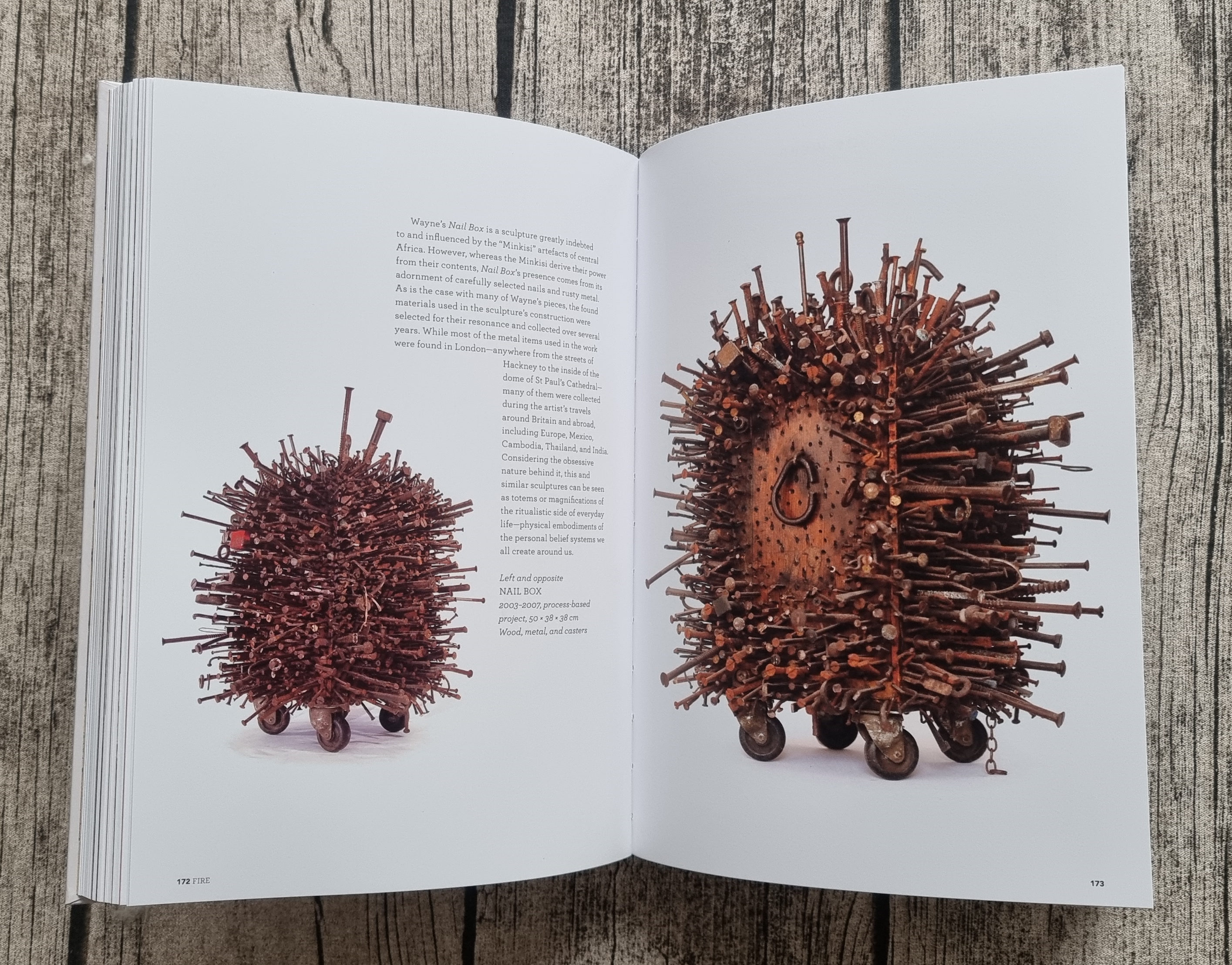
As you can see in this little video that I made the morning that the book arrived through my letterbox, it features four of my sculptures, Crutch and Tumour Box, Tattooed Tumour Box, Horned Orifice God Box, and two photos of my Nail Box sculpture. 


For anyone who would like to order a copy of the book you might like to know that I ordered my copy from hive.co.uk. Not only are they cheaper than the next cheapest, Amazon and Blackwells, but for every purchase from them they make a donation to an independent book shop close to you. As a massive bibliophile myself, I'm all for anything that helps independent book shops stay afloat, especially in these difficult times.